• Planning a Shrub Border

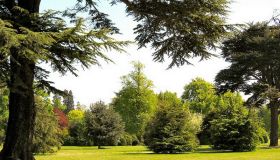
    Shrub BorderA shrub border is a beautiful addition to your landscape. Besides being attractive, it will give you privacy and provide cover (and possibly food) for backyard wildlife.

    There are three characteristics of a successful shrub border:

    1. Seasonal Interest
    2. Repetition
    3. Diversity

    Seasonal Interest

    The goal of almost every gardener is to have a full four seasons of interest in their landscape.If you develop your shrub border with this in mind, our long Michigan winters will still give you something pretty to look at. The three things that will ensure seasonal interest are form, color, and texture.

    Form

    You should go for at least three different forms for the shrubs in your border. The forms are:

    Tall Pyramid: These are usually evergreens, such as pine trees, arborvitae, and spruces. (Yes, yes, I know. These are trees, not shrubs-but they are typically slow growers, easy to prune to keep growth in check, and offer color year round.)

    Vases: These are shrubs that have narrow bases and branch out, getting fuller as they get taller. Examples of these are pussy willows, dogwoods, and forsythias. Keep in mind that I am talking about the natural growth habit of these shrubs. If you prune everything into spheres and cubes, you never see the beautiful natural habit of landscape plants. It is much more interesting to let them do their thing.

    Round: These grow more or less in a spherical shape in your garden-soft and round. Hydrangeas, privets, boxwoods, viburnums, and many dwarf lilacs fit this shape.

    Spreading: These grow low and wide. Some junipers, yews, and cotoneasters fit this shape.

    Color

    Shrub BorderThis is, of course, where the evergreens come in. You can get evergreens in every color from the silvery-blue of some spruces, to the deep green of yews, to the yellow of some types of arborvitae. But don’t stop there. Look at the color of the bark on deciduous shrubs. Red Osier Dogwoods give your landscape bright red accents in fall and winter. Look for shrubs with magnificent fall color. Most viburnums are absolutely gorgeous in fall. I have an Autumn Jazz viburnum that burns yellow, orange, and red in autumn, as well as Summer Snowflake viburnum, whose leaves turn a reddish-purple in fall. Look for plants that have fruit in fall and winter, such as hollies, viburnums, and privets. And pussy willow is wonderful for year round interest. In fall, the catkins are large and reddish, showing off brilliantly after the leaves fall. In late winter, the catkins start to burst, revealing their fuzzy “blooms.” My pussy willows alone have made late winter a lot more bearable.

    Texture

    Evergreens give great texture. You can have everything from the fine, soft needles of white pines, to the coarse, short needles of spruces, to the wide, lacy ones of arborvitae. For deciduous shrubs, look at the branches. The shape of the branches after the leaves have fallen gives wonderful texture.Some shrubs, such as dogwoods, are neat, tidy, and upright, while viburnums will reveal a slightly arching habit of their branches. Also, if you’re lucky, you will be able to find a shrub that features exfoliating bark, such as Dart’s Gold Ninebark (not a very common shrub around our area nurseries. I’d love to have one!)

    My shrub border has made me a lot fonder of winter. One of the most beautiful sights is after a snowfall, and a light dusting of snow clings to all the different branches of the shrubs in my yard. It looks so perfect and magical I can’t help but appreciate winter.

    Repetition and Diversity

    Shrub BorderI put these two seemingly opposite traits together for a reason. When I talk about repetition, I’m not talking about some stringent (you must have three of this, and five of this) kind of design. Gardening, at its essence, is really about falling in love with plants, isn’t it? Most gardeners find a plant that they love, and then find a place for it, despite all the advice we’ve been given about the importance of planning ahead. But why fight our natural inclination to fall in love?It’s what makes gardening fun. So don’t get wrapped up in that kind of thinking. What I mean by repetition is to try to have some kind of repetition of form, to give your garden some structure. For example, my shrub border contains two Tall Pyramids: a white pine and an arborvitae on the ends of the border. Interspersed between these two “bookends” are some Round shrubs: dwarf lilac, viburnum, and pussy willows. I have also included the Vase-shaped red dogwood. My goal is to add a couple Spreaders at some point. But do you see what I mean? I have a wide variety of plants, but their forms give the border repetition and structure, keeping it all from looking like a big mess. In addition, I have found that my diverse landscape is attractive to some of my favorite backyard birds, such as Mourning Doves, Cardinals, and Woodpeckers.

    This method of planning will give you a beautiful landscape, and let you have fun designing it. It just doesn’t get better than that!

    Leave a Reply

    Your email address will not be published. Required fields are marked *